
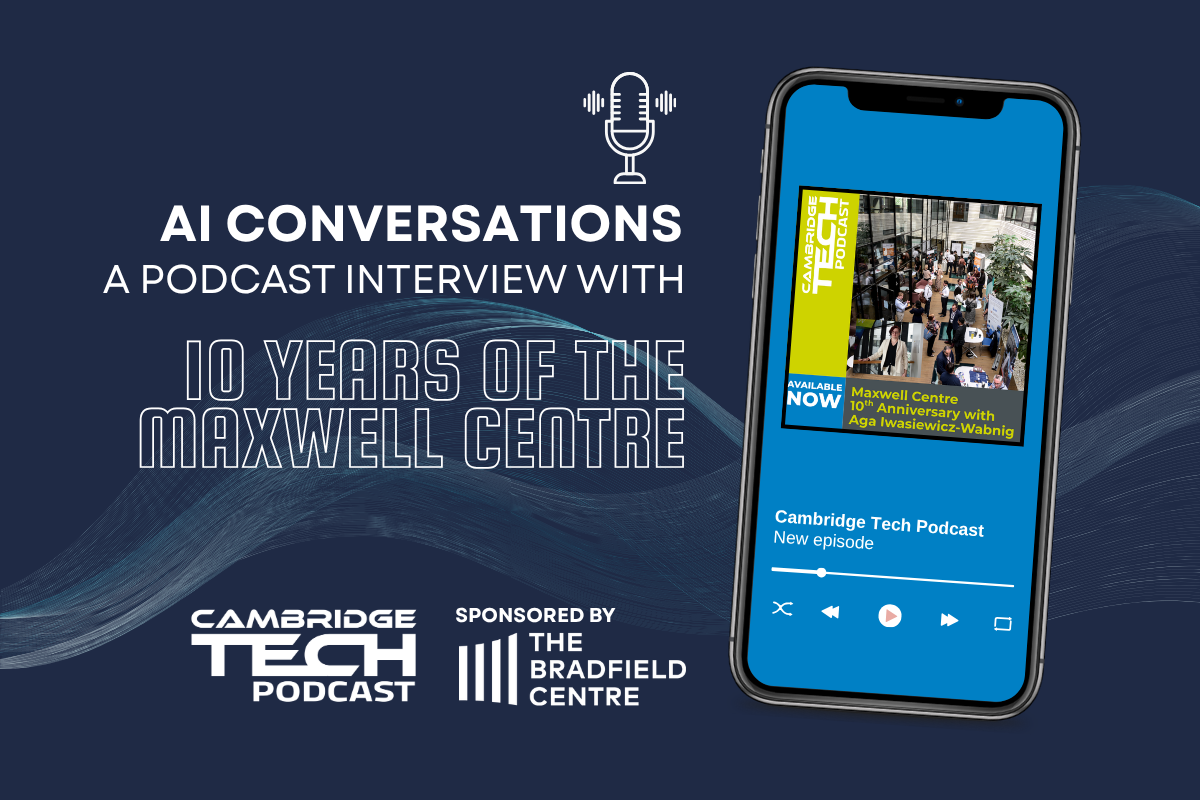
James heads to the Maxwell Centre at the University of Cambridge to mark its first decade, sitting down with four remarkable people who between them span the full arc from foundational physics research to frontier AI startups. If you want to understand how Cambridge actually turns brilliant science into world-changing companies, this is the episode to listen to.
The Maxwell Centre opened in 2016 as a deliberate act of disruption: a place where academics, industry partners and entrepreneurs could work side by side without walls or barriers. A decade later, it has become one of the most quietly influential spaces in the UK innovation landscape.
Five Conversations, One Big Picture
Professor Sir Richard Friend FRS FREng, Founding Director, Maxwell Centre
The man who conceived the Maxwell Centre reflects on why it was necessary and what it has become. A £20 million gift from Cambridge alumnus Sir David Harding, founder of Winton Group, provided the entry ticket to government co-investment that made the building possible. The vision from day one was radical: abolish the barriers between disciplines, between academia and industry, and between research and real-world application.
"The old definitions of areas of activity should not act as impediments to the free flow of ideas." — Professor Sir Richard Friend
Professor George Malliaras FRS, Prince Philip Professor of Technology and Director, Institute for Biomedical Innovation (IBI)
A world authority on bioelectronics and neurotech, Malliaras explains the mission of the newly formed IBI: to reduce the failure rate of medtech spin-outs and accelerate the journey from concept to clinical validation.
The IBI is open to anyone, from Cambridge academics to large industry, and is working towards ISO certification to enable small-volume production for early-stage companies. He flags neurotechnology as a field on the cusp of a step change, with semiconductor-scale manufacturing enabling the next wave of implantable and wearable neural devices.
Deep brain stimulation has existed for 25 years; the next generation of devices will be manufactured at semiconductor scale, enabling mass deployment
Autoimmune conditions are now being explored as targets for neurotechnology treatments
Combination therapies with stem cells represent a highly promising but regulatory-complex frontier
Loubna Bouarfa, Founder, FactTrace
One of Cambridge's most accomplished serial founders. After building and selling OKRA.ai, Bouarfa has emerged from stealth with FactTrace: an AI infrastructure company that extracts a semantic fingerprint from facts and traces them as they move through the information ecosystem, even as they are paraphrased, summarised or transformed by AI. Think Shazam for meaning rather than music.
Currently working on a securities filing use case and has landed its first customer
Targets regulated industries including financial services, healthcare and government, where provenance of information is mission critical
The business model is in development; the technology reduces rather than increases AI token usage, inverting the incentive structure of most AI platforms
"FactTrace is infrastructure technology. It gives important facts a small digital fingerprint so they can be recognised, checked, and traced wherever they appear." — Loubna Bouarfa
Sterlina Smith, Global Lead for AI and Society, SAS
SAS, the 50-year-old data and AI company headquartered in Cary, North Carolina, established its Advanced Analytics Hub at the Maxwell Centre in 2024. Smith leads the company's AI ethics, governance and Data for Good programme globally, and brings a practitioner's perspective to some of the most important questions in responsible AI deployment.
AI governance is not policy theater: written policies in a drawer that no one applies are not governance
The four pillars of SAS's governance framework: culture, operations, controls and oversight
Data for Good projects span the Galapagos sea turtles, the International Organization for Migration, and maternal health initiatives in Uganda
Dr Aga Iwasiewicz-Wabnig, Director, Maxwell Centre
The Centre's current director, who has been part of the Maxwell journey from day one, wraps the episode with her vision for the next decade. She is also the Blue Sky Lead for Cambridge NeuroWorks, the ARIA-funded neurotechnology programme. Her ambition for 2036: AI that is genuinely sustainable, technology that addresses mental as well as physical health, and a materials revolution that solves the critical mineral scarcity problem globally.
"You're never going to run out of good challenges to tackle. And if you're in a place like Cambridge where other people are doing their 150% to tackle the problem they're passionate about, it's just impossible to stand still." — Dr Aga Iwasiewicz-Wabnig
Produced by Joe Donaghy of Cambridge TV. Supported by media partner Business Weekly.